Sponge-bag
The sponge-bag, a checked rubber toilet bag belonging to the American passenger Caroline Martha Hubbard, is a seemingly ordinary object that acquires extraordinary significance in the investigation of Samuel Edward Ratchett's murder. Its placement on the handle of the communicating door between Mrs. Hubbard's compartment and the victim's, and the discovery of the murder weapon hidden inside it, transform it from a piece of personal luggage into a key piece of physical evidence that exposes a critical flaw in the conspirators' carefully staged crime.
Discovery and the Weapon
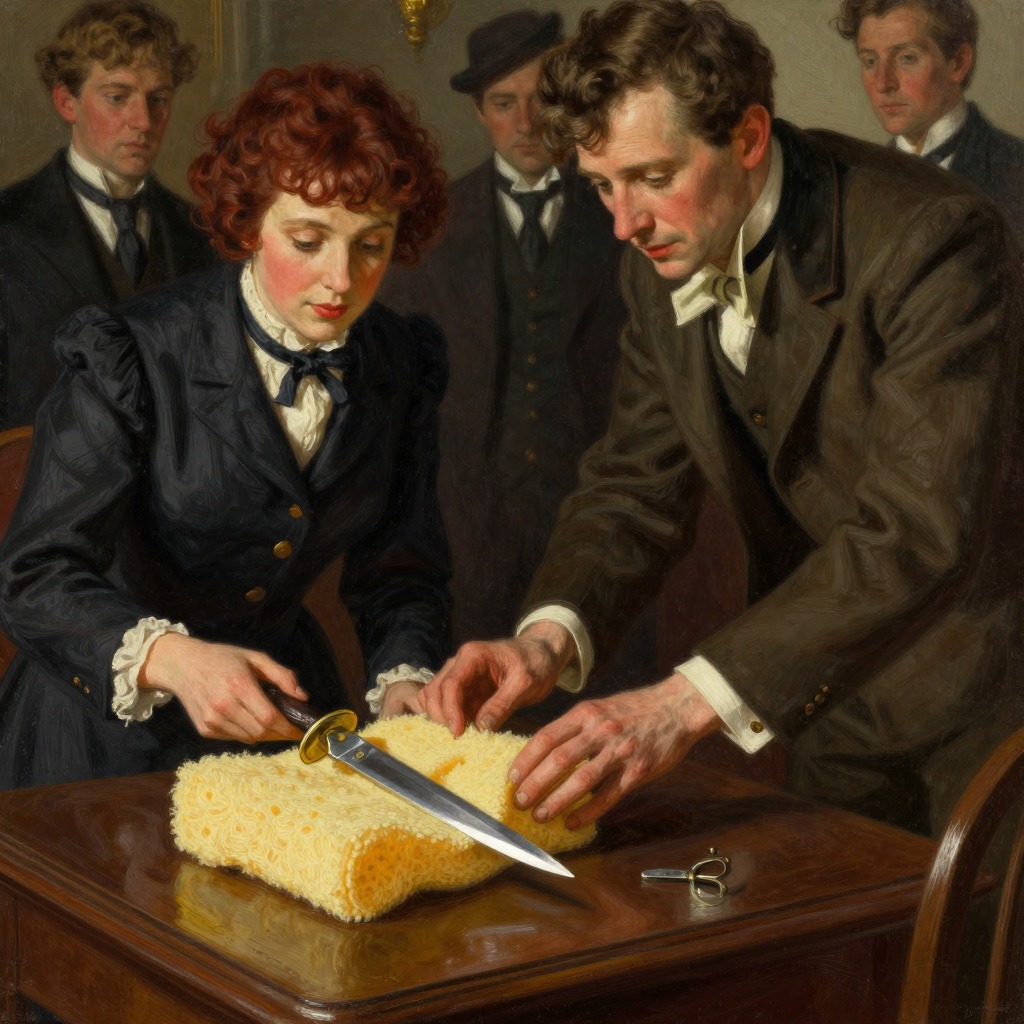
The sponge-bag first becomes a focus of the investigation when Mrs. Hubbard, in a state of high agitation, bursts into the dining-car and announces that she has found a blood-stained dagger inside it. She had hung the bag on the handle of the communicating door, and when she later retrieved it, she discovered the weapon—a straight-bladed dagger with a sham Oriental hilt—concealed within. The discovery of the weapon in this location immediately suggests a narrative: the murderer, having stabbed Ratchett, passed through Mrs. Hubbard's compartment and, in a moment of improvisation, slipped the incriminating knife into the sponge-bag before escaping into the corridor. This interpretation is readily adopted by M. Bouc, who sees it as a logical part of the killer's flight.
The Position of the Sponge-Bag and a Contradiction
Poirot, however, is not satisfied with this simple explanation. He focuses on the precise position of the sponge-bag in relation to the door bolt. Mrs. Hubbard had claimed that on the night of the murder, she was unable to see whether the communicating door was bolted from her bed because the sponge-bag was hanging on the door handle, masking the bolt. She had therefore asked the Swedish passenger, Greta Ohlsson, to check it for her. Poirot reconstructs the scene, hanging the sponge-bag on the handle himself, and confirms that from the angle of her bunk, the bolt would indeed have been hidden. This detail initially seems to support her story. However, Poirot later realizes a crucial inconsistency: the bolt on the door of compartment No. 3, which Mrs. Hubbard occupied, is located well above the handle, not directly beneath it. The sponge-bag, therefore, could not have masked the bolt at all. This discovery forces Poirot to the conclusion that Mrs. Hubbard's entire account of the incident—the request to check the bolt, the claim of being unable to see it herself—was an invention, a piece of staged testimony designed to support the false narrative of an intruder passing through her compartment.
The Sponge-Bag as a Symbol of the Conspiracy
The sponge-bag thus becomes a symbol of the conspirators' meticulous but flawed planning. Its role in the plot was to provide a plausible reason for Mrs. Hubbard to have been unable to verify the bolt's status, thereby allowing her to later claim that the murderer must have entered through the unlocked door. The placement of the dagger inside it was a further improvisation, intended to provide a convenient hiding place for the weapon and to reinforce the impression of a hurried, panicked killer. The object's failure to perform its intended function—the bolt was not where the conspirators assumed it would be—exposes the artificiality of the entire scene. In the final confession, Linda Arden, the actress playing the role of Mrs. Hubbard, acknowledges this mistake, admitting that the error arose because they had rehearsed the scene in a different compartment where the bolt was in a different position. The sponge-bag, a humble toiletry item, thus becomes the material evidence that unravels the perfect crime, a testament to the power of a single, overlooked physical detail to expose a vast and intricate conspiracy.